
What We Clean
The full unit — every component that affects performance and air quality.
Evaporator coil
Condenser coil
Blower wheel and fan
Filters
Drain pan & line
Base pan & passages
Our process
From power down to test run — here's exactly what to expect.
The unit is turned off and disconnected before any work begins.
Filters and the front panel are removed. Filters are cleaned separately and inspected.
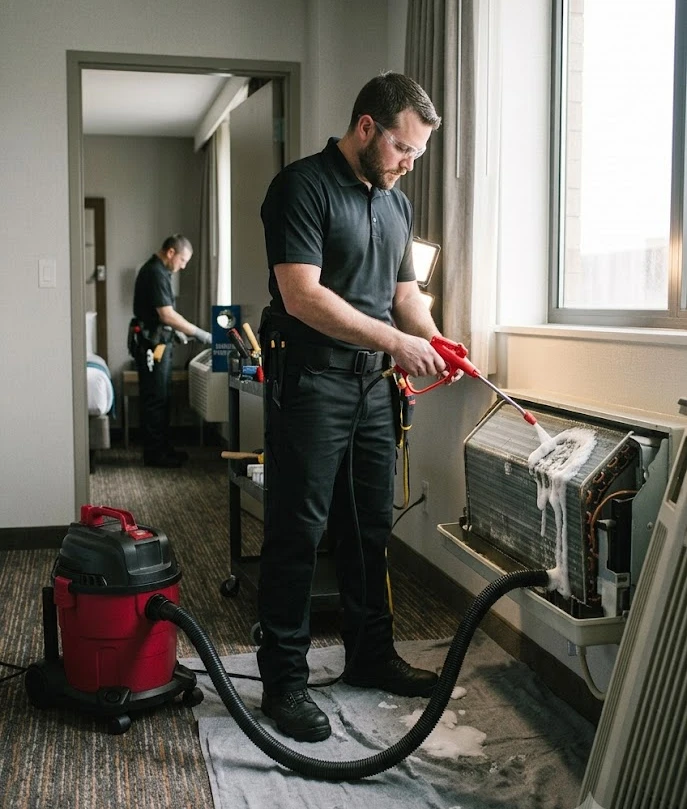
A non-acidic, biodegradable coil cleaner is applied to the evaporator and condenser coils to break down accumulated dust, grease, and biological growth before the rinse.
Both coils are flushed with low-pressure hot water — high enough to remove debris, low enough to protect the delicate aluminum fins. Wastewater is collected and removed.
The blower wheel and fan are cleaned to remove the biological growth and debris that restrict airflow and cause odor.
The drain pan is cleaned of biological growth and debris. The condensate drain line is cleared and confirmed flowing freely.
Caulk seal and foam gaskets around the sleeve are inspected for gaps, air leaks, and water infiltration.
Everything is reassembled. The unit is powered on and tested in both heating and cooling modes to confirm proper operation.